
How I Failed FAR Studying 8hrs a Day, Then Passed All 4 in 3 Months Studying Just 2hrs a Day
If you're studying for the CPA exams, or you need to get them done but you've been putting it off, you're probably dealing with one of three problems:
Problem 1:
You're putting in hours every day, but as the topics pile up and the weeks go by, you feel more overwhelmed and less sure you're going to pass.
Problem 2:
Your studying is working, but it's so time-consuming and stressful that you've wondered more than once if there's a more efficient way to do this.
Problem 3:
You haven't started yet because you're not ready to have studying take over your life.
Going into my first FAR exam, I had a mix of the first two. I was studying six to eight hours a day, I gave up most of my summer, and I still didn't feel ready.
Then I got my score back: a 74.
And by then, I'd already started working full time in public accounting. So now I had to figure out how to pass with a fraction of the time I'd just spent failing.
This page is the story of how I did that. And more importantly, what I figured out along the way that you can use to pass your own sections faster, whichever of those three problems you've got.
The "Normal" Way of Studying (and Why It Felt So Awful)
I finished my master's in May with a job lined up at a mid-sized firm starting in August. My big plan was to pass all four sections that summer so I could show up on day one already done.
That dream died in about three days.
I typed my four exam dates into my review course's study planner, and it spit out what I needed to cover each day. It was taking me seven or eight hours just to get through the video lectures for one day's assignment. So I scrapped the plan and put everything into FAR, since everyone said it was the hardest one.
Here's what a typical day looked like. You've probably lived some version of this.
I'd sit down and start the video lecture. Five or ten minutes in, I'd realize I had completely zoned out and had no idea what the professor just said. So I'd start it over. At one point I was literally staring at her mouth on the screen and mouthing the words along with her just to force myself to pay attention.
An hour or two later I'd finally get through the lecture, skim the chapter, and feel like I sort of understood the lesson. Then I'd go to the practice questions for that exact lesson I just watched... and I couldn't answer them. So I'd think, okay, I guess I need to watch the lecture again.
And then the next day, I'd do it all over again with a brand new lesson. And the next day. One lesson after another, never really looking back.
The problem is, the FAR blueprints have something like 240 different topics on them. By the time you're halfway through, you're six weeks removed from the first things you studied. Honestly, even two weeks back was pretty much gone. So you just keep piling new stuff on top, and the whole time there's this growing feeling in the back of your mind that none of it is sticking.
That's the part nobody tells you. It's not that you're not working hard enough. You can do everything your review course tells you to do, put in the hours every single day, and still feel less prepared the further you go.
Getting a 74, and Then Starting a 60-Hour-a-Week Job
I did my two-week final review, which was basically me trying to relearn two and a half months of material in two weeks. I took two full practice exams. Then I spent the last few days drilling the three or four "weak areas" the review course flagged for me, while ignoring the 200-something other topics that were just as likely to show up.
Then I walked into the testing center, and within the first few questions I knew I'd made a huge mistake.
I had spent tons of time on the hardest stuff, like dollar-value LIFO, because I just assumed the real exam would be all hard questions. Instead, I kept getting these one-line conceptual questions. No calculations. Just a definition, basically. And two or three of the answers all looked right, because I couldn't pull that stuff out of my brain anymore. I remember sitting there thinking, holy crap, I spent all my time on the wrong things.
A few weeks later, and a couple weeks into my new job, I got my score. 74.
I'll be honest, that one hurt. I spent the next two days reading everything I could about getting my score re-reviewed, until I found out that basically never changes anything. Then I took a week or two off mentally, because I just didn't want to think about it.
The hardest part to accept was that I hadn't slacked off. I wasn't working that summer. I studied seven or eight hours a day, every day, and I still failed. And now I was working 60-hour weeks. So the voice in my head was saying, if you couldn't pass with all day to study, how in the hell are you going to pass now?
But there was not a chance I was going to quit. The only reason I got a master's in accounting was to take this stupid test.
So one weekend I sat down and did two things. First, I wrote out my "why," meaning what passing would change for me and what wouldn't change if I didn't. I'd been doing that for goals since I was a teenager reading Tony Robbins books. Second, I got completely honest about my situation. I'd be at work by 7 a.m. and home around 6 or 7 p.m. every weekday, too fried to learn anything new at night. Four hours a day of studying was just not happening.
So whatever I did next, it had to work in about two hours a day. Which meant I couldn't just do more of what I did the first time. I had to figure out what actually mattered.
The 3 Things That Actually Matter (and the Normal Way Gets All 3 Wrong)
When I looked back at my first attempt, I realized my problem was never effort. The normal way of studying has three flaws built right into it, and they're the reason that more hours doesn't fix anything.
1. You're learning topics in "textbook context" instead of "test day context."
Take any lesson in your review course. The lecture and the chapter cover all the background, all the ins and outs, why the rules are set up the way they are. But if you go through every practice question for that lesson, you'll notice the questions only come from the same three or four key areas. Most of what you spent two hours on never shows up as a question.
That's also why the lecture felt like a presentation in a foreign language. You're hearing all this information with no idea what you're actually supposed to be pulling out of it.
2. You never go back.
The normal way is linear. Lesson 1, lesson 2, lesson 3, and you never look back. Every day, four hours of brand new material pushes out most of what you learned the day before. Stretch that over two or three months and it's no wonder the final review feels like relearning the whole thing from scratch.
It's also why those easy conceptual questions killed me on test day. I'd seen all of that stuff. It just wasn't in my head anymore.
3. You're only counting time at your desk.
Everyone assumes studying only happens when you sit down with your review course for a big block of time. But between your commute, your lunch break, waiting in line, and all the little gaps in your day, there are probably another two or three hours you're not using. For someone working full time, that's the difference between "not enough time" and plenty.
Once I saw those three things, it was obvious why grinding harder the first time didn't work. And more importantly, it was obvious what to change.
The 2-Hour Study Session
So I built my whole study process around fixing those three things. I got up early every morning, while my brain was still fresh, and studied for two hours before work.
The first 90 minutes: questions first. Instead of lecture, then chapter, then questions, I flipped it around and went straight to the practice questions. I used them as my main learning tool instead of a test of what I already knew. That way, I was learning each topic the way it actually gets tested.
It's kind of like riding a bike. I can tell you how to do it, but there's a feel to it you only get by doing it. Once I got the hang of it, I could get through lessons insanely fast. When I hit a really tough lesson where I clearly needed the underlying framework, I'd still do the questions first, then watch the lecture. And the lecture would magically make sense the first time, because now I knew exactly what I was trying to learn from it.
The last 30 minutes: re-review everything. At the end of every session, I'd generate one quiz of 30 questions pulled from every lesson I'd covered so far. If I finished lesson 10 today, the quiz came from lessons 1 through 10. Tomorrow it was 1 through 11. Nothing ever got the chance to fade.
Then the rest of the day: study in small chunks on my phone. Commute, lunch, standing in line, whatever. I'd listen to audio notes, read review notes, and do quizzes in five-minute bursts. That added another two or three hours of study time a day without cutting into anything.
On weekends I'd catch up if I'd fallen behind, so I never started a Monday behind my study plan.
Here's how it turned out. I scheduled my FAR retake and my Audit exam in the same week, a Monday and a Friday. My senior at work told me that was completely idiotic and I should move them. He was probably right. But I walked into that FAR retake and it felt totally different from the first time.
I passed FAR. I passed Audit. I didn't take a single day off after that, and I went straight into the next section and then the last one. I passed both.
It wasn't until I got that last score back and looked at the dates that I realized something. From my FAR retake to my last section, I'd passed all four in three months. Working full time. Studying about two hours a day at my desk.
Which, if you remember, was my original goal. I just had to fail first and throw out the normal way to get there.
The Problem: The Phone Part Was Miserable
The method worked. But I'll be honest, one part of it was a real pain, and that was all the studying I was doing on my phone.
The study tools that existed back then were not made for studying in five-minute chunks. I bought review notes from one company and ended up trying to read a Word document on my phone. I bought audio notes from another company, and they ran something like 40 hours just to cover FAR once. By the time you got through them, you were back in the same sea of information as the review course.
And the review course app used full-strength exam questions. So you'd be standing in line at the grocery store and up pops an entire income statement you're supposed to analyze on a phone screen. Not happening.
I made it work anyway, because I had to. But it was clunky and frustrating, and I knew most people wouldn't stick with it.
Then a funny thing happened at the firm. Word got around that I'd passed all four so fast, and I kind of turned into the CPA exam guru at work. People kept coming to me asking how to study, and I ended up coaching coworkers through their study process.
The part that always took the longest to click was questions-first. Telling someone "use the questions as your learning tool" only goes so far. What actually worked was sitting next to them and walking through questions together, showing them how I broke each one down: what it's really asking, which answers you can toss right away, and what the key concept is.
The approach worked for them too. But I could only sit down with so many people one-on-one. And every one of them hit the same wall I did: the method made sense, but the tools to actually do it throughout the day just didn't exist.
So I Built the Tools I Wished I'd Had
That's how SuperfastCPA started. I realized the method wasn't the hard part. The hard part was that nobody had built anything to actually support it. So I decided to build it myself.
I started with the two things I'd needed most: a clear way to teach the study process, and tools designed from the ground up for studying on your phone in small chunks.
It took a lot longer than I expected. Condensing an entire section into something you can actually use on your phone, without losing what you need for the exam, is not a quick job. But the goal was always the same. Take what worked for me and make it something anyone could do, even with a full-time job and a life.
Here's what that turned into:
The Study Process Pro course. This is where you learn the method itself.
The 2-hour study session training walks you step by step through going questions-first, setting up your daily re-review, and planning your weeks so you never fall behind.
MCQ walkthrough videos. For every topic on the AICPA blueprints, we walk through 10 unique multiple-choice questions on video. So you're learning each topic through questions, the way it's actually tested. And at the same time, topic after topic, you're watching exactly how to break a question down until you can do it on your own. It's the closest thing to sitting next to me while I study.
The study tools. These are built for the two or three extra hours you pick up on your phone.
Review notes that condense each section down to what actually shows up on the exam, readable in a few minutes at a time.
Audio notes that are short enough to actually loop through again and again, instead of 40 hours of content you get through once.
Quizzes with the calculation questions rewritten using round numbers, so you can still practice the calculations, but you can do them in your head while you're standing in line.
And none of this replaces your review course. It's designed to work right alongside Becker, Gleim, Roger, or whatever you're using. Your review course is where the 2-hour session happens. SuperfastCPA is how you do that session the right way, and how you pick up the extra two or three hours everywhere else.
People Just Like You Are Passing This Way
The part I'm proudest of isn't my own story. It's the people who've used this to pass their own exams.
I've recorded over 200 interviews with SuperfastCPA customers on our podcast, and I hear the same thing over and over. They're not geniuses, and they didn't have unlimited time. They're working full time, raising kids, commuting, and they figured out how to fit this in without it taking over their lives.
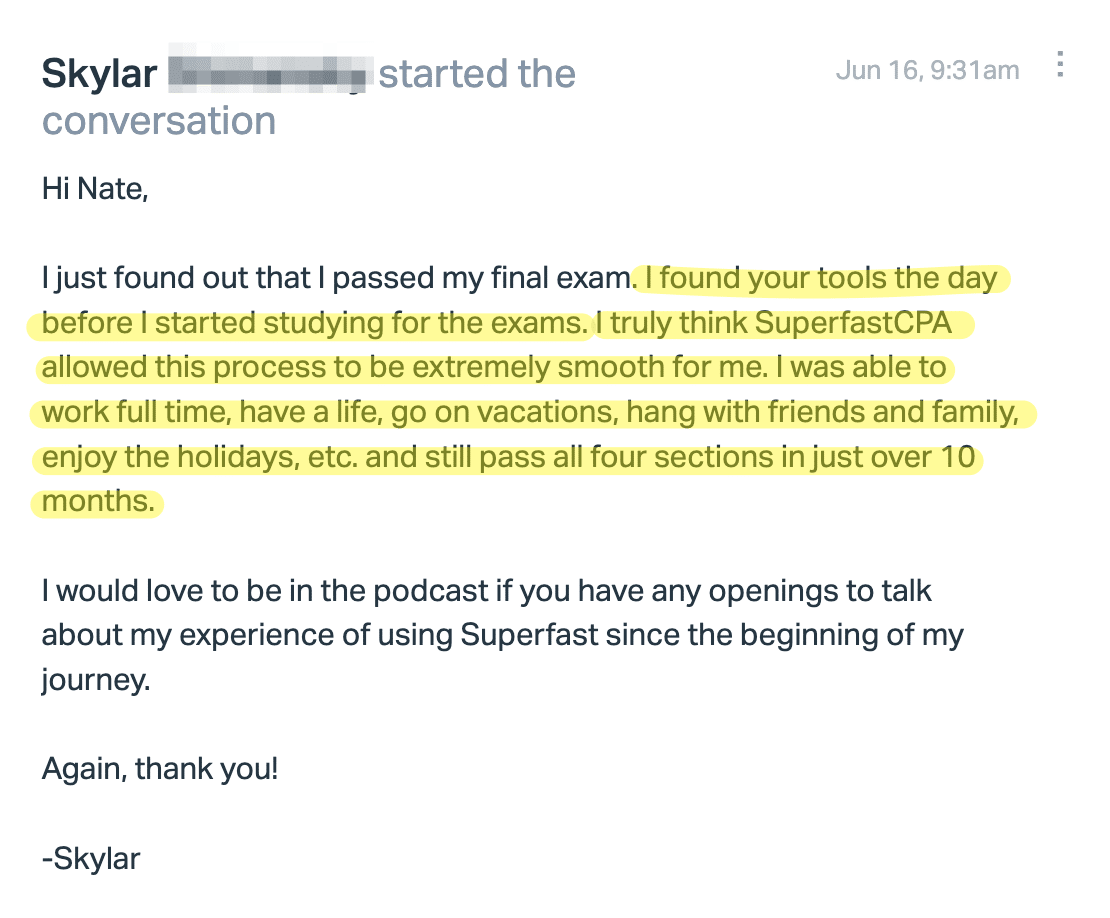
From failing to passing with SuperfastCPA
Started with SuperfastCPA from the beginning
If you're dealing with any of those three problems from the top of this page, one of these people was exactly where you are. The only difference is they stopped grinding the normal way and started studying strategically.
So Which Kind of Candidate Are You Going to Be?
Here's the way I see it. There are two kinds of CPA candidates.
The first kind keeps doing it the normal way. They watch the lecture, rewatch the lecture, move on to the next lesson, and hope enough of it sticks by test day. Sometimes they pass. A lot of times they get a 74. Either way, it eats months of their life.
The second kind studies strategically. They learn every topic the way it's actually tested. They re-review every single day so nothing slips. And they get their two hours in at their desk, then quietly pick up another two or three throughout the day. They're not working harder than everyone else. They're just not wasting the work.
If you're in problem one, that's how you stop the overwhelm. If you're in problem two, that's how you get your nights and weekends back. And if you haven't started yet, you get to skip the miserable version completely and start the right way on day one.
Here's How to Get Started
Study Pro Course
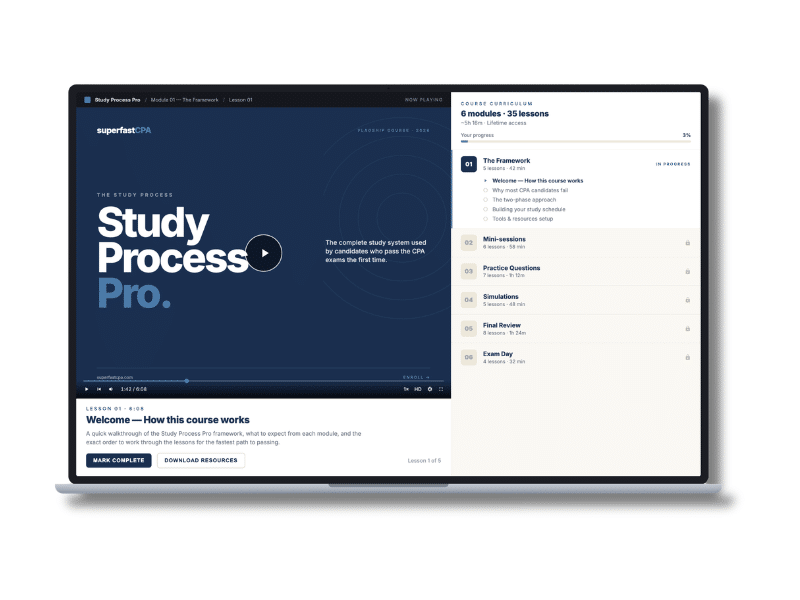
A step-by-step system for making your main study sessions more effective.
- 12 strategy walkthrough videos
- MCQ and SIM strategy walkthroughs
- Slides and worksheets
- PRO discussion forum
- Works alongside any review course
Total Bundle
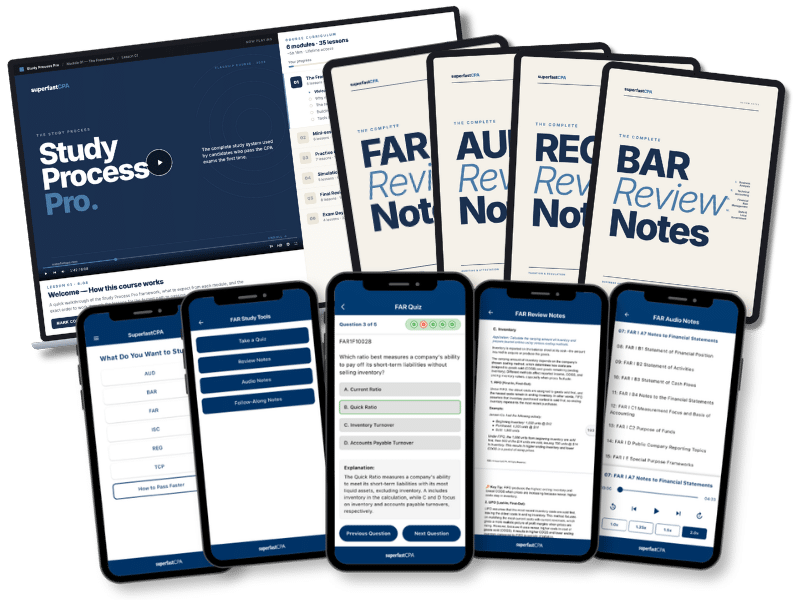
The Study Pro Course plus all the study tools. Our recommendation if you have all four exams ahead of you.
- Everything in both bundles
- The complete Study Pro Course
- Review notes, audio notes & mini quizzes
- SuperfastCPA companion app access
- SuperfastCPA 60-day guarantee
Study Tools Bundle
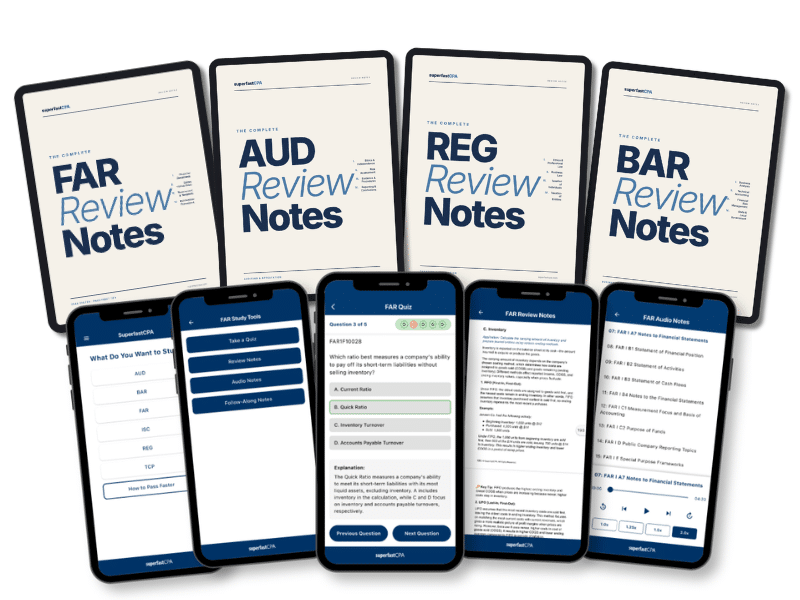
Simplify the material and turn the small gaps in your day into useful review.
- Review notes for all four sections
- Audio notes for all four sections
- Mini quizzes for on-the-go review
- Source documents and audio files
- SuperfastCPA companion app access
Whichever one you pick, it works right alongside the review course you already have.
Every week you spend studying the normal way is another week of material slipping out of your head. You already know which kind of candidate you want to be. Let's get you there.